
 Dan
Dan2021. What an interesting year. With the world turned upside down by a pandemic that seemingly had its sights set on...

GenAI and Knowledgebase: The Way to Build Your Next Nonstop Team
TIC
 Andy Vasey
GenAI and Knowledgebase: The Way to Build Your Next Nonstop Team
Many HPE Nonstop sites share the same concern. The people who built and ran these systems for years are getting close to retirement. They know the history, the shortcuts, and all the “landmines.” When they leave, the applications will still be running, but the real understanding of how everything fits together may not.
Finding fully trained Nonstop replacements is difficult. There simply are not enough experienced Nonstop professionals in the market, especially anyone who is not already close to retirement. The only realistic plan is to build a new team and give them something the previous generation often did not have: a living, searchable knowledgebase of how your Nonstop applications and a new onboarding and training strategy.
Not Just Training
When people talk about the skills gap, the first instinct is to talk about training: which courses to send people to, what topics to cover, which tools to introduce. Those are all important, but they assume that the underlying knowledge is already written down somewhere. Nonstop training provides platform knowledge, but nothing specific to a particular company’s environment or application codebase.
Applications have been extended and patched over many years. Integrations were added through the decades. Documentation usually lagged behind or stopped altogether. Product manuals describe the platform, but they do not explain your specific combination of programs, files, tables, and business rules. In practice, the “knowledgebase” is a mix of source code, a few diagrams, and what senior staff remember. When those people retire, the knowledgebase retires with them.
Meeting newcomers’ needs
The next generation will not be Nonstop “lifers”, who had learned mainly through decades of on hand experience. They arrive with experience on Windows, Linux, and cloud platforms, and they think in terms of web services, REST APIs, containers, and common SQL databases. Nonstop can look foreign at first, but underneath there is a lot they already understand. The trick is to help them “connect the dots.”
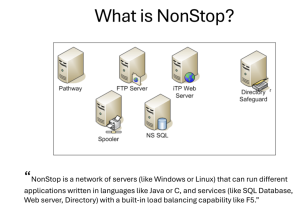
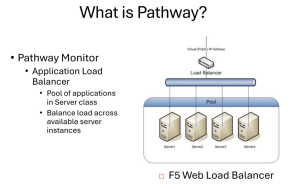
For example, describing Nonstop as “a network of servers working together for continuous availability gives them a mental picture that feels familiar. Pathway requester/server can be introduced as an internal service model that uses inter‑process messaging, much like web services talking over HTTP or message queues. Pathway itself has strong echoes of IBM CICS, or of an IIS application pool plus an F5 load balancer managing incoming work. Nonstop SQL looks and feels like other SQL platforms from a syntax point of view, but with parallel, fault‑tolerant behavior baked in by design.
One learning path does not fit everyone
Even with good analogies, there is no single “Nonstop 101” that works for everyone. A Java developer, a database engineer, and an operations specialist all need different starting points and different depth. Some want the big picture first. Others want to jump straight into code and error logs.
What they all need is a way to learn that adapts to them. That means being able to look up how something works in your environment, not just in a generic manual. It also means being able to ask specific questions about real programs and processes and get clear answers when they are stuck. To make that possible, you need more than static slides. You need a knowledgebase that reflects the actual system and that can be explored in many ways.

TIC Navigator: Building the Nonstop knowledgebase
GenAI- powered TIC Navigator was designed with exactly this in mind. It takes a Nonstop codebase and uses GenAI techniques to generate useful, practical information: program summaries, call relationships, data usage, and insights into where important business logic sits. The result is closer to a living Nonstop knowledgebase than a static set of documents.
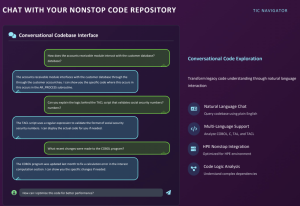
TIC Navigator’s CHAT feature makes this knowledgebase easy to use. A developer can ask, “Where do we calculate this fee?” or “Which programs update this table?” A support engineer can ask, “What happens when this message arrives at this Pathway server?” or “What components will be affected if we change this field?” The answers are grounded in the actual analyzed code and metadata. Developers can start getting answers themselves without being blocked.
Beyond onboarding: everyday value
Once you have a Nonstop knowledgebase in place, it helps far beyond the first few months of onboarding. It becomes a shared reference point for troubleshooting, planning changes, and thinking about modernization. Teams can see where dependencies are, which pieces are safe to touch, and where to be careful.
It also takes pressure off your SME and senior staff. The knowledgebase handles repetitive lookups.Instead of having to answer the same “Where is this?” and “How does that work?” questions, SME can focus on mentoring, design decisions, and planning. And getting their “REAL day job” done. That is how you build your next Nonstop team – and that is how you keep the platform strong for years to come.
The human side: N2NS and community
Even with good tools, people still learn best from other people. That is why community efforts like New to Nonstop (N2NS) matter so much. N2NS connects new members with mentors, peers, and curated resources across customers, partners, and vendors. Through sessions, Rotary talks, and networking, N2NS helps newcomers understand the technology and also what a Nonstop career can look like.
TIC Software has always believed that the future of Nonstop depends on people as much as on technology. Alongside modernization and integration projects, TIC has spent years on education and community work to help grow the Nonstop talent pool. That is why TIC has stepped up as part of N2NS, bringing decades of application development, modernization, and project experience to mentoring and knowledge sharing. When you combine that kind of human support with a Navigator‑built knowledgebase, you give new team members both a guide and a map.
Future Proofing Nonstop with the Next Generation
GenAI and knowledgebases are not about replacing training; they make training and everyday learning more effective. By turning your Nonstop code into a living knowledgebase, and by backing it up with mentors and a community like N2NS, you give the next generation a real chance to succeed.
Contact us to learn more about TIC Mentorship and TIC Navigator.
“Elevate your digital experience”
