
 Dan
2021. What an interesting year. With the world turned upside down by a pandemic that seemingly had its sights set on...

Don’t Let a Failover Reveal Your Data Problems
Gravic
 Andy Vasey
Don’t Let a Failover Reveal Your Data Problems

Your recovery system is online. Replication is running, and the target database appears to be caught up. If production becomes unavailable, how do you know the data on that system is ready to support the business?
For organizations running mission-critical applications on HPE Nonstop, that question belongs in everyday operations. Recovery readiness is more than knowing your systems are available—it is knowing, with confidence, that the data your business depends on will be there when it matters most. Independent validation provides that assurance by proving the source and target databases match, exposing hidden discrepancies before a failover, migration, or downstream application turns them into a business-critical crisis.
The Risk of Silent Inconsistencies
A replication failure is a highly visible event to operational teams. Silent inconsistencies are much harder to recognize because data movement may continue normally while part of the target database diverges from the source.
For example, a new table may be added to an application without being included in replication. TMF audit flags may not be restored after maintenance, or a database change may be applied differently across environments. Replication can continue processing the changes it is configured to handle while these gaps remain undetected.
Monitoring replication health is essential, but it answers a different question from comparing database contents. Independent validation examines the data itself and gives teams a way to uncover differences that operational status alone may not reveal.
Validate Before the Business Depends on the Target
The loss of a production database leaves little room to investigate whether the recovery copy is usable. Regular comparisons give teams an opportunity to detect, investigate, and resolve discrepancies while the source is still available.
Validation should also be an explicit part of migration cutover planning. After the initial load and ongoing change data capture replication bring the target up to date, teams can compare the databases, repair any discrepancies, and revalidate before switching production to the new environment. The same discipline supports disaster recovery testing, platform refreshes, and replication solution replacements.
This makes validation a practical decision point. A completed load or a healthy replication status is supported by evidence about the data that applications will actually use.
Use Validation History to Focus the Investigation
Scheduled validation also helps answer an important troubleshooting question: when did the databases last match? Consider comparisons that show matching data at 8 a.m., 10 a.m., and noon, followed by a discrepancy at 2 p.m. That history gives the team a two-hour window to investigate, rather than searching through an entire day of activity.
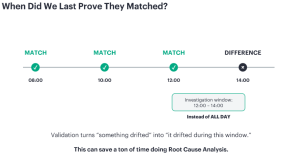
Teams can focus on maintenance, configuration changes, or application activity within that window. After identifying the cause and correcting the affected data, another comparison confirms whether the discrepancy has been resolved. Repairing the data and addressing the underlying cause are both necessary to keep the issue from returning.
Extend Confidence Beyond Disaster Recovery
 Nonstop data increasingly supports reporting, analytics, fraud detection, and other enterprise services. A transaction may feed several systems, each making a different decision from the information it receives. An available downstream system can still produce an incorrect result if its data is incomplete or inconsistent.
Cross-platform environments add complexity because database engines, data types, and schemas may differ. Validation must account for how the data is represented and mapped between systems. It must also distinguish persistent discrepancies from temporary differences caused by normal replication latency.
The scope of validation therefore needs to follow the data beyond the recovery site. As more business processes rely on replicated information, regular comparisons help teams establish confidence in the copies those processes consume.
Put Validation Into Routine Operations With Shadowbase Compare
Shadowbase Compare and Compare Plus help teams incorporate Data Validation into their operational procedures. Online comparison allows applications to continue updating their databases during validation, while latency filtering helps avoid false mismatches. Detailed discrepancy reports support investigation and remediation, followed by revalidation to check the results.
Compare Plus extends validation across platforms, helping organizations verify data shared between HPE Nonstop and Other Server databases. Teams can schedule comparisons as part of routine operations and include validation in recovery and migration procedures. Check with Gravic for the latest supported platform combinations and capabilities.
Together, these practices support digital resiliency by giving teams evidence they can use when deciding whether to recover, cut over, or rely on downstream data. A useful place to start is to ask when your critical databases were last compared, what those comparisons covered, and whether any outstanding differences have been resolved.
To learn how Gravic Shadowbase data validation can support your environment, contact your Shadowbase representative or visit ShadowbaseSoftware.com.
If you would like us to present on anything related to this topic to you or your staff, please contact us.
Hewlett Packard Enterprise globally sells and supports Shadowbase solutions under the name Shadowbase Solutions for HPE Nonstop software. For more information, please contact your local Shadowbase representative or visit our website.
For additional information, please view our Shadowbase solution videos: Vimeo.com/ShadowbaseSoftware, or follow us on LinkedIn. Assisted in part with AI tools. Specifications subject to change without notice. Trademarks mentioned are the property of their respective owners. Copyright © Gravic, Inc. 2026.
